

Q4 - People You May Know (Ranking Friend Suggestions)
We believe a variation of this interview question has recently been asked by Meta to software engineering candidates. People You May Know is one of Meta's most famous features, and underneath it is a graph question: whom do you share the most friends with? Part 1 is the clean mutual-friends ranking; Part 2 is the refinement that separates a real signal from noise, the friend who is connected to nearly everyone.
Scenario: You are given a social graph as a list of undirected friendships, each [a, b] meaning users a and b are friends, plus one user id. Build the feature that suggests People You May Know: other users this person likely knows but is not yet friends with.
Part 1. Return a ranked list of suggested user ids for user, ordered by the number of mutual friends they share (friends the two have in common), most first. Exclude the user themselves and anyone already their friend, and only suggest someone with at least one mutual friend. Break ties by smaller id.
⏱️ On pacing a multi-part question. Interviewers usually do not reveal Part 2 until you have finished Part 1, and you often will not even know more parts are coming. So get Part 1 correct and clean without burning the whole slot on it, and keep some time in reserve for whatever comes next.
Example 1 (Part 1: rank by mutual friends)
Input:  friendships = [[0,1],[0,2],[0,3],[1,4],[2,4],[3,4],[1,5],[2,5],[3,6],[3,7],[3,8]]
        user = 0
Output: [4, 5, 6, 7, 8]
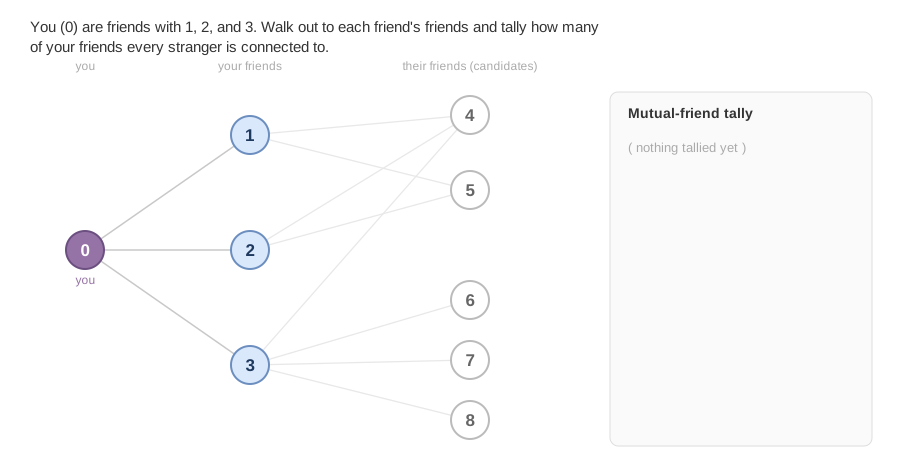
Why: You (0) are friends with 1, 2, 3. Candidate 4 shares all three (3 mutual),
        candidate 5 shares 1 and 2 (2 mutual), and 6, 7, 8 each share only friend 3
        (1 mutual). Ranked by mutual count, ties by id: [4, 5, 6, 7, 8].
💡 A friend of a friend, counted. You never compare the user against everyone. The only people worth suggesting are friends of your friends, so walk out exactly two hops: for each of your friends, look at their friends, and tally how often each stranger shows up. That tally is the mutual-friend count, and it costs you one pass over the graph instead of an all-pairs comparison.
Part 1: Count Mutual Friends, Then Rank
The suggestions live two hops out (friends of your friends), and getting there takes three small steps.
Step 1: Build the friend map
Turn the flat edge list into an adjacency map: friendsOf[x] is the set of everyone x is friends with. Each [a, b] adds b to a's set and a to b's, since friendship goes both ways.
build friendsOf from the edges:

   0  ->  {1, 2, 3}          (you)
   1  ->  {0, 4, 5}
   2  ->  {0, 4, 5}
   3  ->  {0, 4, 6, 7, 8}    (friend 3 is friends with a crowd)
   4  ->  {1, 2, 3}
   5  ->  {1, 2}
   6, 7, 8  ->  {3}
Step 2: Walk two hops and tally mutual friends
Your friends are friendsOf[user], here {1, 2, 3}. For each friend, look at their friends. Anyone who is not you and not already your friend is a candidate, and every time you reach them you have found one more friend you share, so bump their tally.
tally each stranger reachable through a friend:

   through friend 1 (friends 4, 5):     4 -> 1,  5 -> 1
   through friend 2 (friends 4, 5):     4 -> 2,  5 -> 2
   through friend 3 (friends 4,6,7,8):  4 -> 3,  6 -> 1,  7 -> 1,  8 -> 1

   mutualCount = { 4: 3, 5: 2, 6: 1, 7: 1, 8: 1 }
That is two nested loops: your friends, then their friends, bumping a tally for every stranger you reach.
for friend in my_friends:                        # a friend of yours
    for candidate in friends_of[friend]:         # a friend of your friend
        if candidate != user and candidate not in my_friends:
            mutual_count[candidate] = mutual_count.get(candidate, 0) + 1   # one more shared friend
Step through that walk frame by frame. Each of your friends lights up in turn, and the strangers they connect you to climb the tally on the right:
Step 3: Rank the candidates
Sort the tallied candidates by mutual count (descending), breaking ties by smaller id.
sort mutualCount by (count desc, id asc):

   { 4:3, 5:2, 6:1, 7:1, 8:1 }  ->  [4, 5, 6, 7, 8]
Notice that 6, 7, and 8 already look like weak suggestions: your only link to them is the single friend 3, who happens to be connected to a crowd. Hold that thought, it is exactly what Part 2 fixes.
# O(F) time, F = total friendship links | O(V) space
def suggestions(friendships, user):
    friends_of = {}
    for a, b in friendships:
        friends_of.setdefault(a, set()).add(b)
        friends_of.setdefault(b, set()).add(a)
    my_friends = friends_of.get(user, set())
    mutual_count = {}
    for friend in my_friends:                        # a friend of yours
        for candidate in friends_of[friend]:         # a friend of your friend
            if candidate != user and candidate not in my_friends:
                mutual_count[candidate] = mutual_count.get(candidate, 0) + 1
    # most mutual friends first; ties broken by smaller id
    return sorted(mutual_count, key=lambda c: (-mutual_count[c], c))
Part 2: Ignore the Friend Who Knows Everyone
The interviewer raises the real-world problem: a hub, someone connected to thousands of people, a celebrity, a brand page, a bot, makes everyone look like a "mutual friend" of everyone else. In Example 1, candidates 6, 7, and 8 were suggested only because you both know user 3, who is friends with a crowd. That is noise, not a real connection.
So add a threshold maxDegree: a shared friend only counts as a mutual connection if their own friend count is at most maxDegree. A hub above that line is skipped entirely, for every candidate. Everything else is the same ranking as Part 1.
Example 2 (Part 2: hub-aware, maxDegree = 3)
Input:  friendships = [[0,1],[0,2],[0,3],[1,4],[2,4],[3,4],[1,5],[2,5],[3,6],[3,7],[3,8]]
        user = 0,  maxDegree = 3
Output: [4, 5]
Why: Friend 3 has 5 friends, above maxDegree = 3, so 3 is a hub and no longer
        counts. That erases 6, 7, 8 (their only link to you was hub 3) and drops
        candidate 4 from 3 mutual to 2 (via friends 1 and 2). Result: [4, 5].
Concretely, it is Part 1 with one extra guard slotted in.
Step 1: Measure each friend's degree
A friend's degree is simply how many friends they have, the size of their set in friendsOf. Compute it once, and any friend whose degree tops maxDegree is a hub.
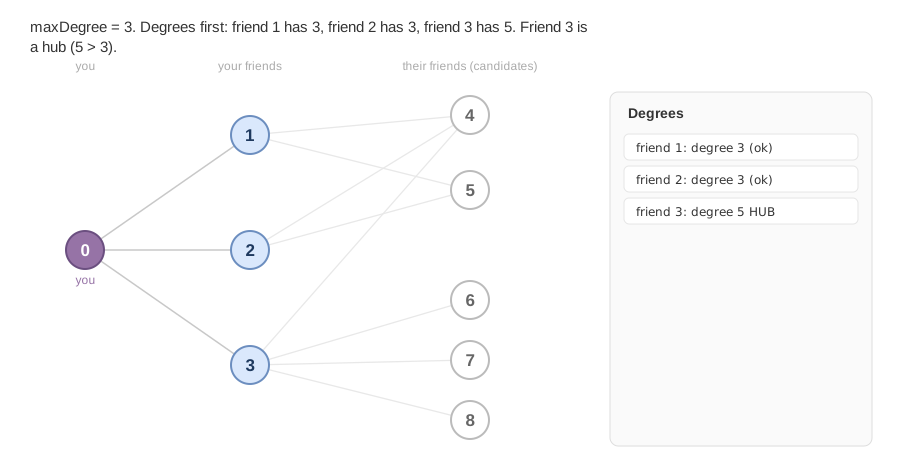
degree = size of each friend set, with maxDegree = 3:

   friend 1: degree 3   (ok)
   friend 2: degree 3   (ok)
   friend 3: degree 5   (hub, 5 > 3)
Step 2: Skip the hubs while you tally
Now run the exact same two-hop walk as Part 1, with one guard: before counting a friend's friends, skip that friend entirely if its degree is above maxDegree. A hub then contributes to no candidate at all, and computing each degree is O(1) (the set's size), so the filter is free.
It is the Part 1 walk with a single guard added at the top of the outer loop.
for friend in my_friends:
    if len(friends_of[friend]) > max_degree:     # a hub is not a meaningful signal, skip it
        continue
    for candidate in friends_of[friend]:         # otherwise, tally exactly as before
        if candidate != user and candidate not in my_friends:
            mutual_count[candidate] = mutual_count.get(candidate, 0) + 1
Watch friend 3 get skipped, and the noise it created, candidates 6, 7, and 8, vanish:
Ranking the survivors then works exactly as in Part 1.
# O(F) time | O(V) space
def suggestions_ignoring_hubs(friendships, user, max_degree):
    friends_of = {}
    for a, b in friendships:
        friends_of.setdefault(a, set()).add(b)
        friends_of.setdefault(b, set()).add(a)
    my_friends = friends_of.get(user, set())
    mutual_count = {}
    for friend in my_friends:
        if len(friends_of[friend]) > max_degree:     # a hub is not a meaningful signal, skip it
            continue
        for candidate in friends_of[friend]:
            if candidate != user and candidate not in my_friends:
                mutual_count[candidate] = mutual_count.get(candidate, 0) + 1
    return sorted(mutual_count, key=lambda c: (-mutual_count[c], c))
Complexity Analysis
- Both parts:
O(F)time, whereFis the total number of friendship links (each edge is added twice to the adjacency map, then walked when its endpoints are visited). Concretely, the two-hop scan touches each of the user's friends and each of their friends once, which sums to the degrees of the user's friends. Ranking the candidates addsO(k log k)forkcandidates. - Space:
O(V + F)for the adjacency map, plusO(k)for the candidate tallies. - The two-hop walk is the whole efficiency story: you never compare the user against the whole network, only against the neighborhood two steps out, which is where every real suggestion lives.
Final Notes
👥 We believe the "People You May Know" problem, and graph-neighborhood questions like it, have appeared frequently in recent interviews for software engineers at Meta. The core is a two-hop walk: build the adjacency map, then count friends-of-friends. The follow-up is the systems instinct, a node connected to everyone carries almost no signal, so weight it down or drop it. Talking through both is most of what the interviewer wants to hear.
- Suggestions live two hops out. You do not score the whole graph, only the friends of your friends. Building the adjacency map and walking out two steps is the entire engine, and saying "I only need the two-hop neighborhood" is the efficiency insight.
- A mutual-friend count is just a tally on that walk. Every time a friend-of-a-friend shows up, you have found one more shared friend. No set intersections per candidate, one pass does it.
- Exclude yourself and your existing friends, and demand at least one mutual. These three filters are easy to forget and are exactly what a careless answer gets wrong. State them before you code.
- Hubs are noise. The person connected to everyone makes strangers look related. Capping the degree of a shared friend, or weighting it down, is the refinement that turns a toy into something you would actually ship. It is the same instinct behind ranking real recommendation systems. 🚀